By Better Little Home · Updated September 18, 2026 · How We Choose
The quickest way to organize a small home is to make everyday items easy to put away. Start with the places where clutter returns most often: the entry, kitchen counter, bathroom sink, bedside table, and work surface. Give each frequently used item one obvious home before you buy another bin or basket.
A small home does not need to look empty to feel calm. Clear pathways, useful surfaces, and storage that fits your routines matter more than matching containers. The 17 ideas below are practical, flexible, and realistic for apartments, compact houses, and shared spaces—start with one problem area and build from there.
Start with three small-space rules
1. Fix friction before adding storage
Notice what lands in the same inconvenient place every day. Shoes near the door, mail on the counter, chargers on the sofa, or skin-care products around the sink are clues. The problem is often not a lack of storage; it is that the available storage is too far away, too full, or too difficult to open.
Move the storage closer to the habit. A hook beside the door usually works better than an empty hanger in a distant closet. A shallow tray where keys already land is more realistic than asking everyone to use a complicated system.
2. Protect open surfaces
In a compact home, one crowded surface can make an entire room feel busy. Decide what each surface is for, then keep only the items that support that job. A dining table can hold a simple centerpiece, but it should not become long-term storage for packages, paperwork, and tools.
3. Measure before you shop
Organizers take up space too. Before buying one, measure the width, depth, and height of the exact location, including the clearance needed for doors, hinges, cords, and baseboards. Then measure the items you want to store. A product is useful only when it fits both the space and the routine.
Entryway ideas
4. Build a one-stop landing zone
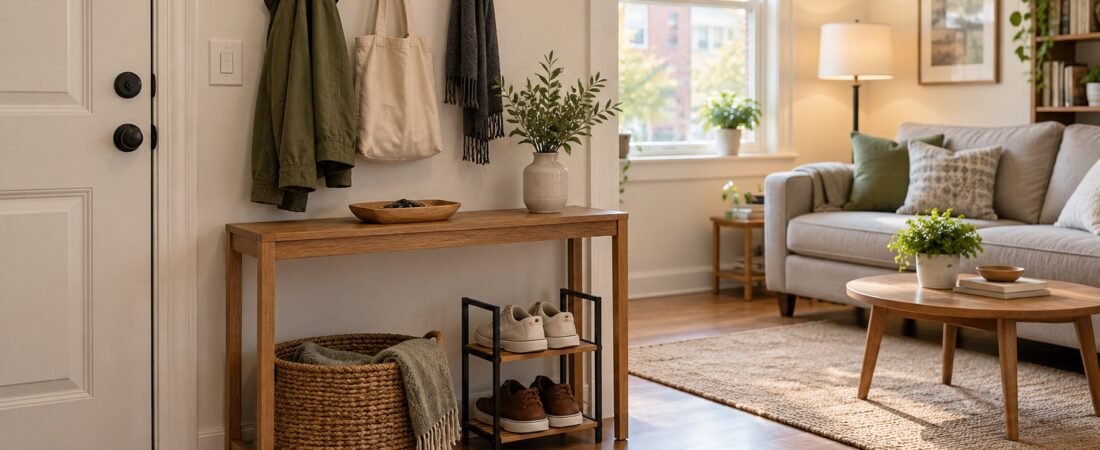
Use the smallest practical area near the entrance for the things that leave and return with you: keys, wallet, dog leash, sunglasses, and outgoing mail. A few sturdy hooks plus a shallow tray can be enough. If several people share the home, assign one hook or small container to each person.
5. Limit shoes to the current rotation
Keep only the shoes you wear this week near the door. Store special-occasion and off-season pairs elsewhere. A narrow rack is helpful when it prevents a pile, but it should not become permission to keep every pair in the entry.
Living room ideas
6. Choose furniture that earns its footprint
Look for pieces that solve at least two real needs, such as an ottoman that provides seating and blanket storage or a side table with a shelf for books. Skip “multifunctional” furniture when the extra function is awkward to access. If you must move three objects and lift a heavy lid every time, you probably will not use the storage.
7. Use one container for each visible category
One basket for throws, one tray for remotes, and one magazine holder for current reading material create clear limits. Avoid lining every wall with small containers. Too many organizing products can look like clutter and make it harder to remember where things belong.
8. Keep the floor edge visible
A little uninterrupted floor around furniture helps a room feel easier to move through. Start by clearing items from corners and from behind doors. If something must live on the floor, group it with similar items instead of scattering pieces around the room.
Kitchen ideas
9. Store by task, not by product type alone
Create small working zones based on what you do: coffee, lunch packing, baking, or food prep. Keep the tools and ingredients for each routine together and near the surface where you use them. This reduces the number of cabinets you open and helps everyone put things back.
10. Put daily items between knee and eye level
Reserve the easiest-to-reach shelves and drawers for things you use most. Store seasonal platters, duplicate appliances, and backup supplies higher or lower. Prime cabinet space is too valuable for items you touch twice a year.
11. Add a shelf riser only where there is wasted height
A riser can make plates, bowls, or pantry staples easier to see, but first check whether the shelf above can be adjusted. Adjustable shelves often solve the same problem without adding another object. Use a riser when it creates a clear second level, not when it simply squeezes more items into a crowded cabinet.
12. Use cabinet doors carefully
The inside of a cabinet door can hold light, flat items such as measuring spoons, cleaning cloths, or a short list of meal ideas. Check that the organizer clears the shelves and does not prevent the door from closing. Avoid heavy storage that strains hinges or swings into fragile items.
Related: Find more practical ideas in our Kitchen section.
Bedroom ideas
13. Measure under-bed space from the lowest point
Bed frames, center supports, and uneven floors can reduce usable height. Measure at several points before choosing containers. Shallow boxes with handles are easier to retrieve than soft bags pushed far out of reach. Use this area for off-season clothing, spare bedding, or items you can label clearly—not for forgotten odds and ends.
14. Keep the bedside setup narrow
Your nightstand only needs to support your evening and morning routines. Make room for a light, a drink, and perhaps a book or phone charger. Keep small personal items in one contained tray. Store medicines in their original containers and where children cannot see or reach them, following the label’s storage directions. For more information, see medication-safety guidance from the FDA and Health Canada. If there is no room for a table, a wall shelf or bedside pocket may work without taking floor space.
15. Set a realistic limit for linens
For many households, two sheet sets per bed and a modest supply of towels are easier to manage than overfilled shelves. Your needs may differ, especially with children, guests, or limited laundry access. Pick a number that covers normal delays, then let the available shelf space be the boundary.
Bathroom ideas
16. Separate daily care from backup supplies
Keep the products you use every day within easy reach. Store refills, travel sizes, and occasional treatments together in a labeled backup area. This prevents duplicates from crowding the sink and makes it easier to see what you already own before shopping.
If several people share a small bathroom, a handled caddy for each person can be simpler than trying to divide one tiny cabinet perfectly.
Related: Browse our Bedroom & Bath guides.
Home office ideas
17. Create a two-minute shutdown routine
At the end of a work session, return pens to one cup, place loose papers in a single inbox, connect devices to their chargers, and clear the main work surface. The goal is not a picture-perfect desk. It is a workspace that is ready the next time you sit down—especially when the desk is also a dining table or part of a bedroom.
Related: Browse our Home Office ideas.
Before buying any organizer
Write down these five details before adding a product to your cart:
- Available width, depth, and height, measured at the narrowest point.
- Door and drawer clearance, including knobs, hinges, and nearby furniture.
- The largest item the organizer must hold.
- How often you need access and whether a lid, latch, or stacked setup will slow you down.
- What will leave the space when the organizer arrives. Storage should replace clutter, not become additional clutter.
Keep the measurements in your phone. They are useful when comparing products in a store and help prevent “almost fits” purchases.
If a low-cost product would genuinely solve the problem, compare measured options in our Under $30 section.
Small-space organizing mistakes to avoid
- Buying containers before sorting. You may end up organizing items you do not need or buying the wrong size.
- Filling every vertical surface. Wall storage is useful, but too many shelves and hooks can make a room feel visually crowded.
- Using deep bins for small items. If you cannot see or reach what is at the bottom, the bin becomes a hiding place.
- Copying a system that does not match your habits. A beautiful setup fails when it requires more steps than your household will repeat.
- Expecting one big declutter to last forever. Small homes need simple reset points because even a few out-of-place items are noticeable.
A simple 30-minute reset
- Choose one high-friction area, not an entire room.
- Remove obvious trash, recycling, and items that belong elsewhere.
- Group what remains by how and when you use it.
- Give the most-used group the easiest location.
- Use a container you already own for one week before buying anything new.
- At the end of the week, adjust the system based on what did not get put away.
Frequently asked questions
How do I organize a small house with no storage?
Start by reducing the number of items competing for the space, then look for overlooked areas near existing habits: the back of a suitable door, a narrow wall, the space beneath a bed, or an empty section inside a cabinet. Prioritize open access for daily items and closed storage for backups. Do not add storage to every available surface; preserve clear pathways and a few calm sightlines.
Do clear bins make a small space look more organized?
Clear bins make contents easy to identify, which can help in a pantry or utility cabinet. They do not automatically reduce visual clutter, especially on open shelves. Opaque containers can look calmer, but they need simple labels. Choose based on where the container will live and how quickly you need to find the contents.
What should I organize first?
Begin with the place that causes the most daily frustration and can be improved in one short session. For many homes, that is the entryway, kitchen counter, or bathroom sink. A small win is easier to maintain and teaches you what kind of system works before you tackle a closet or an entire room.
The bottom line
A well-organized small home is not one that hides the most belongings. It is one where important things are easy to find, easy to use, and easy to put back. Solve one recurring problem at a time, measure before buying, and leave a little breathing room. Those habits do more than any single organizer.
Explore more practical ideas in Small Spaces and Organization, or read How We Choose before using one of our future product recommendations.